Getting started
Tensor
A ten::tensor<T, Rank> or stensor<T, Dims...> aka ten::ranked_tensor<T, Shape, Order, Storage, Allocator> is a multidimensional array. The number of dimensions is unlimited.
By default a tensor is colum major that is its data is in a contiguous column. Support for row major tensors is limited.
ten::tensor<float, 3> x({2, 3, 4});
// Access indices with () operator
x(0, 0, 1) = 1.f;
// Access linear indices with [] operator
x[0] = 1.f;
x[23] = 1.f;
Examples of a static tensor:
ten::stensor<float, 2, 3, 4> x;
// Access indices with () operator
x(0, 0, 1) = 1.f;
// Access linear indices with [] operator
x[0] = 1.f;
x[23] = 1.f;
The number of dimensions of a tensor is returned by the function rank(). The nth dimension is returned by dim(n) and the size of the tensor is returned by size().
ten::tensor<float, 3> x({2, 3, 4});
std::cout << x.rank() << std::endl; // 3
std::cout << x.dim(0) << std::endl; // 2
std::cout << x.dim(1) << std::endl; // 3
std::cout << x.dim(2) << std::endl; // 4
std::cout << x.size() << std::endl; // 2*3*4 = 24
By default most functions don’t copy the tensor, it can be copied by calling copy().
ten::tensor<float, 3> x({2, 3, 4});
auto y = x.copy();
Constructors
The following constructors are defined for vectors, matrices, and tensors:
Vector
// Uninitialized vector
ten::vector<T> x({size});
// Vector initialized with data
ten::vector<T> y({size}, data);
Static vector
ten::svector<float, size> x;
ten::svector<float, size> y(data);
Matrix
ten::matrix<float> x(shape);
ten::matrix<float> y(shape, data);
Static matrix
ten::smatrix<float, dims...> x;
ten::smatrix<float, dims...> y(data);
Tensor
ten::tensor<float> x(shape);
ten::tensor<float> y(shape, data);
Static tensor
ten::stensor<float, dims...> x;
ten::stensor<float, dims...> y(data);
Special matrices
Transposed
ten::matrix<float> x = ten::range<ten::matrix<float>>(shape);
auto y = ten::transposed(x);
std::cout << std::boolalpha << y.is_transposed() << std::endl;
Symmetric
ten::matrix<float> x(shape, data);
auto y = ten::symmetric(x);
std::cout << std::boolalpha << y.is_symmetric() << std::endl;
Hermitian
ten::matrix<std::complex<float>> x(shape, data);
auto y = ten::hermitian(x);
std::cout << std::boolalpha << y.is_hermitian() << std::endl;
Lower triangular
ten::matrix<float> x(shape, data);
auto y = ten::lower_tr(x);
std::cout << std::boolalpha << y.is_lower_tr() << std::endl;
Upper triangular
ten::matrix<float> x(shape, data);
auto y = ten::upper_tr(x);
std::cout << std::boolalpha << y.is_upper_tr() << std::endl;
Serialization
A tensor can be saved in binary format (extension .ten) or in matrix market format.
Example:
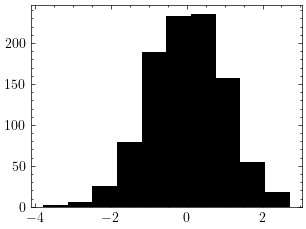
// Normal distribution
ten::normal norm;
// Sample from a normal distribution
ten::vector<float> x = norm.sample(1000);
// Save to a mtx file (Matrix Market format)
ten::save_mtx(x, "norm.mtx");
The saved file can be loaded in numpy:
import numpy as np
import scipy as sp
import matplotlib.pyplot as plt
import seaborn as sn
plt.style.use("science")
a = sp.io.mmread("norm.mtx").flatten()
plt.hist(a, color = "black")
plt.show()