Getting started
API
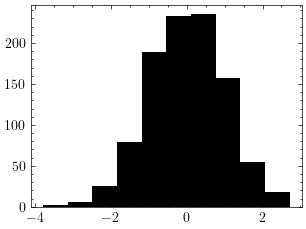
Tenseur has an easy to use api, It can be illustrated with the following example:
// Normal distribution
ten::normal norm;
// Sample from a normal distribution
ten::vector<float> x = norm.sample(1000);
// Save to a mtx file (Matrix Market format)
ten::save_mtx(x, "norm.mtx");
The saved file can be loaded in numpy:
import numpy as np
import scipy as sp
import matplotlib.pyplot as plt
import seaborn as sn
plt.style.use("science")
a = sp.io.mmread("norm.mtx").flatten()
plt.hist(a, color = "black")
plt.show()
Constructors
The following constructors are defined for vectors, matrices, and tensors:
Vector
size_t size = 5;
// Uninitialized vector
ten::vector<T> x({size});
// Vector initialized with data
ten::vector<T> y({size}, {0., 1., 2., 3., 4.});
Static vector
constexpr size_t size = 5;
ten::svector<float, size> x;
ten::svector<float, size> y({0., 1., 2., 3., 4.});
Matrix
ten::matrix<float> x({2, 3});
ten::matrix<float> y({2, 3}, {0., 1., 2., 3., 4., 5.});
Static matrix
ten::smatrix<float, 2, 3> x;
ten::smatrix<float, 2, 3> y({0., 1., 2., 3., 4., 5.});
Tensor
ten::tensor<float> x({2, 3, 4});
ten::tensor<float> y({2, 3}, {0., 1., 2., 3., 4., 5.});
Static tensor
ten::stensor<float, 2, 3, 4> x;
ten::stensor<float, 2, 3> y({0., 1., 2., 3., 4., 5.});
Special matrices
Transposed
ten::matrix<float> x = ten::range<ten::matrix<float>>({2, 3});
auto y = ten::transposed(x);
std::cout << std::boolalpha << y.is_transposed() << std::endl;
Symmetric
ten::matrix<float> x({2, 2}, {1.0f, 0.0f, 0.0f, 1.0f});
auto y = ten::symmetric(x);
std::cout << std::boolalpha << y.is_symmetric() << std::endl;
Hermitian
ten::matrix<std::complex<float>> x({2, 2}, {1.0f, 1.0f-1.0i, 1.0f + 1.0i, 2.0f});
auto y = ten::hermitian(x);
std::cout << std::boolalpha << y.is_hermitian() << std::endl;
std::cout << y << std::endl;
Lower triangular
ten::matrix<float> x({2, 2}, {1.0f, 2.0f, 0.0f, 3.0f});
auto y = ten::lower_tr(x);
std::cout << std::boolalpha << y.is_lower_tr() << std::endl;
std::cout << y << std::endl;
Upper triangular
ten::matrix<float> x({2, 2}, {1.0f, 0.0f, 2.0f, 3.0f});
auto y = ten::upper_tr(x);
std::cout << std::boolalpha << y.is_upper_tr() << std::endl;
std::cout << y << std::endl;